




Overview
BSG Ecology provided ecological support to Northumberland Estates (the land owner) and K W Purvis Ltd (the quarry operator) for the proposed extension of Longhoughton Quarry, Northumberland. Whin grassland (a rare habitat type) and roosting bats were recorded on site during survey work; measures were identified to protect and enhance the grassland and achieve a licence solution that allowed the development to proceed in line with project timelines.
The project was consented in November 2019.
Challenge
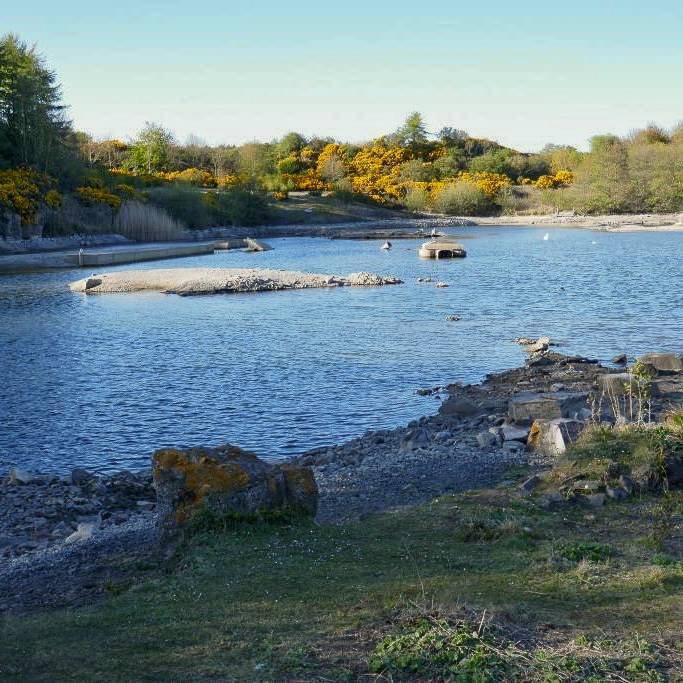
The proposed quarry extension area covers approximately 20.5 hectares of land including an extant section of quarry, a quarry lake adjoined by vertical rock faces in places, and adjacent farmland.
The main ecological challenges for the scheme were to determine whether any protected Whin grassland habitat (a priority habitat for conservation in Northumberland) was present in the extant quarry area, and whether bat species were roosting in the quarry faces. If roosting bats were present a licence would need to be secured quickly to allow the continued quarrying of rock, otherwise work would have to stop until a licence had been granted.
Solution
An initial extended Phase 1 habitat survey was conducted which identified an area where the vegetation was indicative of Whin grassland. Further botanical survey confirmed this corresponded to Whin grassland, a rare and protected grassland habitat[1].
Measures were proposed to protect and enhance the area of Whin grassland, including the erection of exclusion fencing to prevent machinery from entering the area during work. Management to protect the grassland from succession to scrub and secondary woodland and to eradicate the invasive species pirri-pirri bur were also identified.
Species surveys revealed that Daubenton’s and Soprano pipistrelle bats were roosting in the rock faces of the extant quarry area. Night vision aids were used to pinpoint roost locations, and temperature monitoring was carried out to better understand the characteristics of the micro-habitats bats were using for roosing.
A licence application was submitted to Natural England to permit the exclusion of the bats prior to quarrying works that would impact on them. This required the identification of appropriate and proportionate mitigation and compensation measures for the species present.
Mitigation ahead of works involved a licensed ecologist examining suitable voids in the rock faces and installing exclusion devices to allow bats to leave but not return to their roosts. In parallel with this the existing quarry lake was dewatered to deter bats by removing their main feeding habitat. Compensation was provided by creating additional roosting opportunities in a nearby disused part of the quarry. Once this had been completed the quarrying work was able to proceed.
Outcome
The Longhoughton Quarry eastern extension planning application was consented in November 2019. The EPSL for bats was granted in April 2021 and work commenced shortly after this.
Testimonial
“BSG Ecology are Northumberland Estates Ecologists of first choice, based on their extensive wide-ranging experience and pragmatic solutions to ecology related development issues.”
Barry Spall, Development Planner, Northumberland Estates
——————-
[1] Whin grassland describes a set of plant communities associated with the geology of the Whin Sill, a tabular layer of the igneous rock dolerite that occurs in northern England and specifically forms cliffs and outcrops on the coast between Howick and Holy Island. Whin grassland is therefore only found at a small number of places, where thin, nutrient-poor soils overlie outcrops of whinstone. (Source: https://www.northumberlandcoast-nl.org.uk/wildflowers/)