


Overview
BSG Ecology was commissioned by RWE Renewables Ltd to provide ecological and ornithological support to their proposed Alwen Forest scheme, Conwy, North Wales. The application concerned nine wind turbines, battery storage, the grid connection and all associated infrastructure. BSG undertook baseline ecological and ornithological data collection, refreshing survey work periodically in response to data ageing and changing scheme design, led detailed stakeholder consultation, completed all related assessment work, produced the habitat management plan for the scheme and represented RWE at the hearing held under the Developments of National Significance Consenting Process. The project was consented in October 2025. BSG is currently supporting RWE with site enabling works ahead of construction.
Challenge
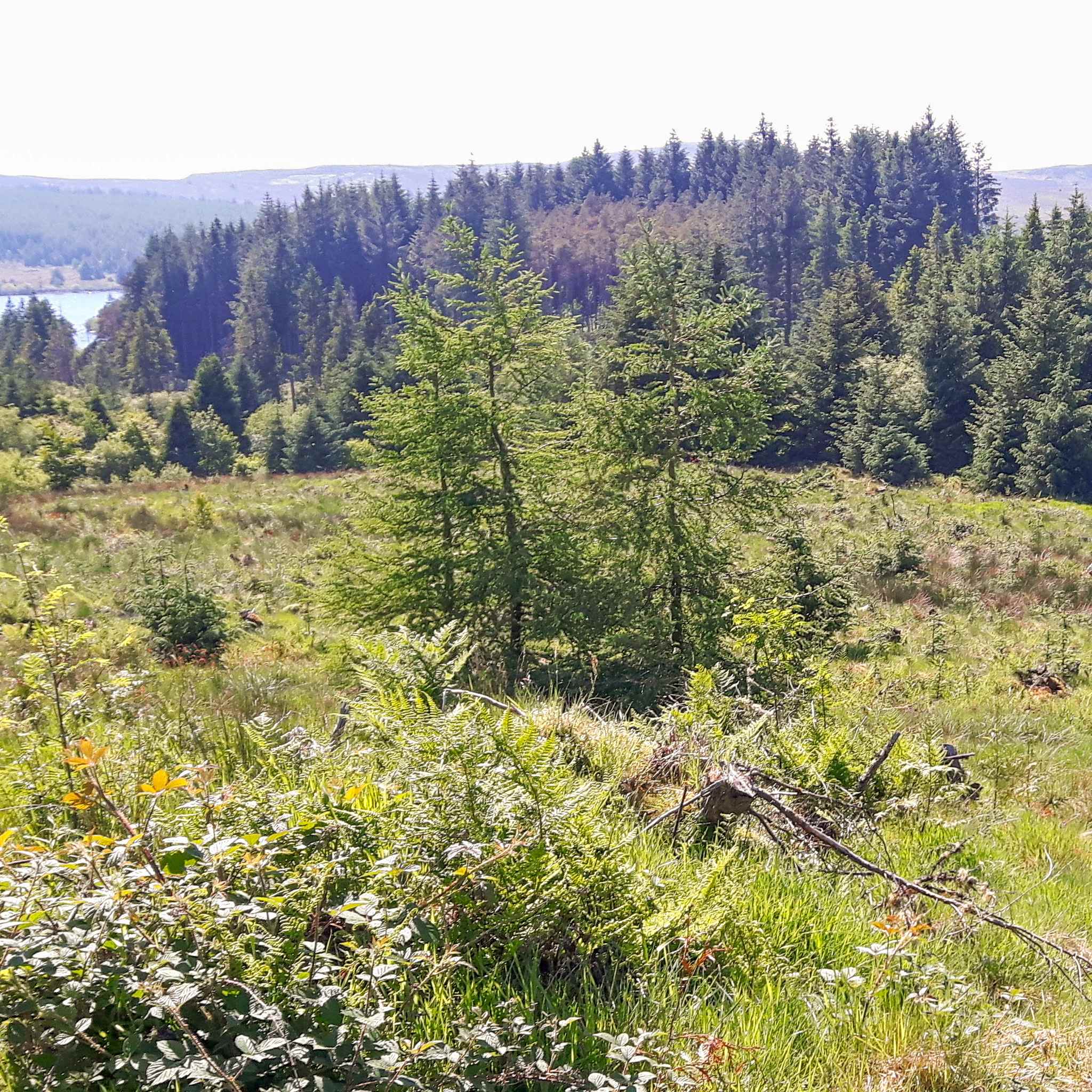
The site is predominantly located in commercial plantation forestry managed by Natural Resources Wales (NRW), and is located to the west of Llyn Brennig, Conwy County Borough. Both Llyn Brennig and Llyn Alwen, which is located within the site boundary, provide important potable water resources. The site also lies adjacent to Mynydd Hiraethog Site of Special Scientific Interest (SSSI), notified for its upland habitats and breeding birds.
Challenges included locally-breeding osprey, goshawk, nightjar, curlew and black grouse, the presence of red squirrel, pine marten and roosting bats, deep peat (in both afforested and non-afforested areas of the site), priority bog and heath habitats, areas of low impact silviculture (LISS) and potential for impacts on water quality.
Liaison between RWE, Dwr Cymru (Welsh Water) and NRW’s Energy Delivery Team concerning the acceptable scale and design of the scheme were protracted; initial surveys commenced in 2017, but submission was not until September 2024. An additional challenge was therefore ensuring that baseline data were refreshed to reflect significant changes in layout and updates to survey guidance and remained an appropriate basis for assessment.
Solution
BSG co-ordinated extensive stakeholder liaison including a series of meetings with NRW’s planning ecologists (through the Discretionary Planning Advice Service) and Energy Delivery Team, the Conwy County Borough Ecologist and RSPB Cymru. These discussions helped understand consultee concerns, establish working relationships and de-risk the approach taken through agreement of the scope of baseline survey work.
Desk study and consultation was used to inform the scope and specification of survey work. Existing data were available for some species (including red squirrel and pine marten), with wide-ranging ornithological, protected species and habitat survey completed to address data gaps. This work allowed some species (such as hazel dormouse) to be scoped out of assessment and informed site design. Survey was periodically updated and extended in response to significant changes in scheme layout and as the need for offsite infrastructure (to allow abnormal indivisible load access) became clear.
BSG’s assessment inputs included the production of the ecology and ornithology chapters of the Environmental Statement, a shadow Habitats Regulations Assessment report (considering the potential for effects on the River Dee and Bala Lake Special Area of Conservation), and outline Habitat Management Plan (HMP) and inputs to the Green Infrastructure Statement.
The HMP was developed in conjunction with a peatland geomorphologist and sets out the measures proposed to achieve a net benefit for biodiversity through the development. The HMP committed RWE to restoration of blanket bog habitat, increasing the extent of priority wet and dry heath habitats, enhancing riparian corridors, improving the water quality of streams and increasing the broadleaved woodland resource on site. These measures will also improve habitat quality for key species such as black grouse and red squirrel. In addition, RWE will complete monitoring of bat fatality and satellite tag young ospreys in order to test residual uncertainty regarding impacts and inform the need for further mitigation.
Following ES submission BSG supported RWE in responding to the pre-hearing (Regulation 15) questions from the Planning Inspector, inputting to Statements of Common Ground with key consultees and preparing a hearing statement to address residual issues. BSG then provided expert witness support during the DNS hearing, in which impacts on peatland habitats, osprey and appropriate mitigation were all discussed.
Outcome
The project was approved by Planning and Environment Decisions Wales (PEDW) on behalf of Welsh Government in October 2025. Initial enabling works commenced in the first quarter of 2026, with BSG providing method statements and on-site support to inform legislative compliance and appropriate dynamic mitigation measures.
Testimonial
‘BSG has provided ecological support on the Alwen Forest project from the project’s very inception through to its eventual planning consent in October 2025. Throughout, BSG has ensured that our surveys of the sensitive flora and fauna within the forest environment are informed by the very latest industry guidance as it has evolved over the years. The final design of our habitat management plan therefore protects the species that are present in the forest, and will provide site-relevant, ongoing and enduring biodiversity enhancement throughout the lifetime of the wind farm.’
Martin Cole, Development Project Manager, RWE Renewables