




Overview
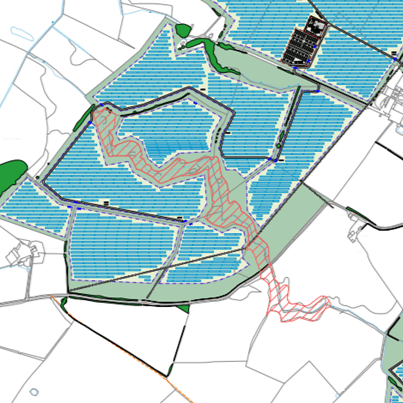
BSG Ecology was commissioned by Enso Energy to provide ecological support for a 160 MW solar development project on Anglesey / Ynys Môn: Alaw Môn Solar Farm. The project, which is located just to the south of Llyn Alaw, will be determined under the Development of National Significance (DNS) consenting regime. BSG managed the Ecological Impact Assessment, from inception (scoping and baseline survey) through to the submission of the Environmental Statement and DNS application. The site was consented by Welsh Government in August 2025.
Challenge
The local landscape context of the project meant that numerous ecological / biological features needed to be considered:
- The project is just to the south of a Site of Scientific Interest (SSSI) that is important for birds, Llyn Alaw.
- Part of a geological SSSI (Nantanog) is within the Site boundary.
- Cors-y-Bol Local Wildlife Site (a wetland) is immediately to the west.
- There are numerous ponds within and close to the Site, and Anglesey has historically supported good populations of great crested newt.
- Other features are present including hedgerows and traditional cloddiau (vegetated, stone-faced earth banks) which form some field boundaries.
It was particularly important to understand the relationship between the Site and Llyn Alaw – and whether birds from the SSSI (which include wintering whooper swan and several duck species) also used the Site.
During the assessment process BSG obtained records of a flock of Greenland white-fronted geese. Birds had been previously reported from Anglesey, but the flock was hitherto poorly documented, with the very small Welsh population centred on the Dyfi Estuary (70kms to the south). Greenland white-fronted geese breed in west Greenland and winter exclusively in Britain and Ireland, The global population is small and has declined significantly to just 18,000 birds in 2023[1]. The Anglesey flock was the subject of an ongoing radiotracking study (through the ECHOES[2] project) that was running concurrently with the baseline survey work at Alaw Môn. The ECHOES project research was unpublished, but the incoming radiotracking data was used to determine how the flock was using Llyn Alaw and the land in the local area as part of the assessment.
It was also important for the project to be able to demonstrate how the ‘DECCA’ principles, as set out in Planning Policy Wales (PPW 24), had been applied through the design of the scheme to help deliver biodiversity net benefit. These principles relate to five attributes of ecosystem resilience: Diversity, Extent, Condition, Connectivity, and Adaptability.
Solution
A structured program of bird survey that included pre-dawn visits to Llyn Alaw and systematic survey of the Site and adjacent areas did not identify a clear relationship with Llyn Alaw and the Site. There was no evidence of use of the Site by whooper swan. One waterbody within the Site was used by a variety of waterfowl and, accordingly, this was retained within the layout with a buffer area following consultation on design mitigation with Natural Resources Wales (NRW). It was also possible to agree a mitigation approach with NRW that would protect Nantanog SSSI and include management measures to enhance the SSSI through scrub removal around geological features.
BSG was able to use satellite tagging data obtained through the ECHOES project to determine that although they were occasionally flying above it when moving between roosts and feeding areas, Greenland white-fronted geese were not using the Site.
The landscape design, which was developed with the project team, includes the retention of existing features of value, including field ponds, small blocks of woodland and field boundaries including hedgerows and cloddiau. The retained features will be buffered throughout the Site with new areas of habitat; linkages between habitats both within and around the Site will be improved. The design will incorporate new woodland and scrub planting, new areas of meadow grassland, and grassland around the perimeter will be allowed to develop a taller sward. It will also include over 4km of additional hedgerow and 14 new ponds, which will benefit the small population of great crested newt recorded. There will be a commitment to manage these features through the lifespan of the project.
Outcome
The work carried out by BSG, including survey, consultation, technical reporting, assessment, and design input has allowed the project to respond to issues identified and raised by consultees. The scheme design is based around the retention and enhancement of ecological features within the Site in accordance with the step-wise approach in Planning Policy Wales and the biodiversity net benefit solution has been devised with reference to the DECCA principles.
The proposed application for a Development of National Significance (DNS) was accepted by Planning and Environment Decisions Wales (PEDW) on 15th September 2023 and was consented by Welsh Government in August 2025.
———
[1] https://greenlandwhitefront.org/
[2] Echoes Project (Effect of climate change on bird habitats around the Irish Sea), co-ordinated by the BTO, Aberystwyth University and others: https://echoesproj.eu/ )